
By Gemma Fraser
Head of content
Police Scotland has been accused of misleading MSPs who sit on Holyrood’s justice committee over safe staffing levels.
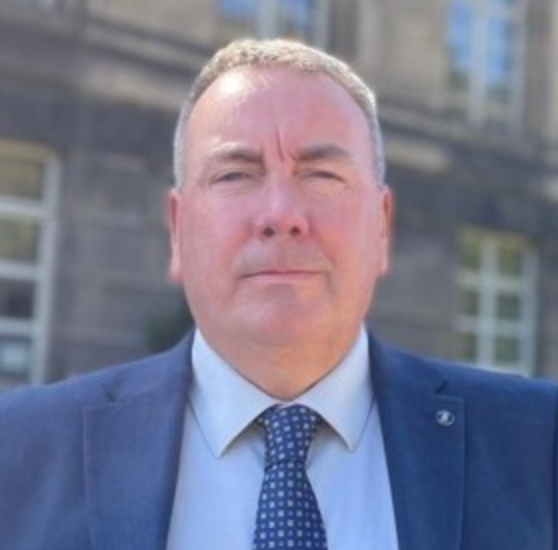
David Threadgold (pictured), chair of the Scottish Police Federation (SPF), said claiming “all is well” in relation to resourcing was a missed opportunity to “demonstrate the true scale of the issue facing the service”.
Threadgold has submitted written evidence to the Criminal Justice Committee highlighting a range of issues over staffing, resourcing, and the scale of non-police demand such as mental health callouts.
His letter followed a meeting in September where Conservative MSP Stephen Kerr questioned Assistant Chief Constable Catriona Paton about running shifts across Scotland “that are below any kind of recognisable safety level”.
ACC Paton replied: “No, we are not.”
However, her comments sparked outrage among rank-and-file officers, leading to Threadgold writing to the committee to clarify their position.
In his letter, he said: “My view is that some of the responses were evasive to the point of confusing or inadvertently misleading committee members, and whilst I’m positive this was never the intention, it was the outcome.
“The pretence that ‘all is well’ should not be maintained at all costs, and admitting that there is an issue should not necessarily be seen as a weakness or failure on behalf of the organisation or any individual within it.
“To try and maintain this position can, in my view, lead to the quality of evidence being diminished, and I know from my working with the representatives who appeared that day that their knowledge and passion for the subject is unquestionable.
“I think this was particularly relevant in Stephen Kerr’s line of questioning directed to ACC Paton about safe staffing levels. Her response created a huge amount of online reaction as it is felt by operational officers to be so far from the truth.”
He continued: “We simply cannot have a situation where members of the Criminal Justice Committee feel that the quality of evidence is not good enough, evasive, or that the default is to ‘corporate speak’ which both fails to answer the question and dilutes the opportunity presented by attending.”
Threadgold also highlighted the challenges faced by officers in dealing with the growing number of mental health-related matters, which account for around 18 per cent of all incidents.
Chief Constable Jo Farrell has previously warned that her officers “cannot continue” responding to these calls on this scale.
The Scottish Government’s framework for collaboration (FFC), which set out principles for a multi-agency approach to supporting people experiencing distress or crisis, was published more than 18 months ago.
But, according to Threadgold, its success has been “at best, extremely limited”.
“In the simplest of terms, Police Scotland became the de-facto leaders of this work,” he said.
“My view is that health board CEOs never fully engaged with the principles of the FFC as to do so would have created more demand at a time of extreme pressure in their areas of business.
“Whilst perhaps understandable when viewed through that lens, it did absolutely nothing to address the issues within policing.
“Without immediate change to the ‘operating model’ within policing, with or without buy in and collaboration with the rest of public sector, the risk is that policing, and police officers, become even more invisible, irrelevant, and removed from the communities we try and serve.”
Police Scotland was approached for comment.