
Police Scotland is at the forefront of plans to use AI to “revolutionise” policing across the UK, slashing the administrative burden on officers and saving millions.
The force is working on a pilot project to train AI to think like a detective, and hopes in the future to use the technology to prepare police reports, freeing up officers to get out on the street.
Police Scotland’s head of major crime, Detective Chief Superintendent Paul Livingstone, said he expects AI will be used in unsolved cases as a failsafe, to ensure no stone is left unturned.
Speaking to 1919 at Police Scotland’s Scottish Senior Investigating Officer (SIO) conference, he said he believes the technology will be beneficial in reviewing cold case murders, such as the killing of Glasgow businessman Alexander Blue in 2002.
He also said it will speed up investigations that deal with large amounts of complex data, such as Operation Stringent, which is investigating disgraced former NHS Tayside surgeon Sam Eljamel.
Livingstone hopes AI will also be able to incorporate body-worn video – now rolled out across Scotland more than two decades after initially being trialled by a UK force – and scan and digitise paper manuscripts.
Police Scotland is leading for the whole of the UK on a pilot project to incorporate AI into the system for major investigations, in collaboration with technology firm Unisys.
Livingstone said of the planned innovations: “We’re hoping that ultimately that will be far more effective, far more efficient.
“It will free up capacity, giving us more capability, and we can then get police officers and investigators out on the street doing investigations.
“The system will do a lot of the automation for us through the use of AI, taking a lot of the administrative burden away from us.
“Unisys see this as a real possibility for the whole of UK policing, not just Police Scotland, to hopefully revolutionise how we do things.
“The hope is it will think like a police officer, an investigator. We hope that will give us prompts, because investigations can be really complex, and you can have the best SIO in the world, but there’s a chance they can miss or overlook something.
“This will give us a prompt to ensure that doesn’t happen.”
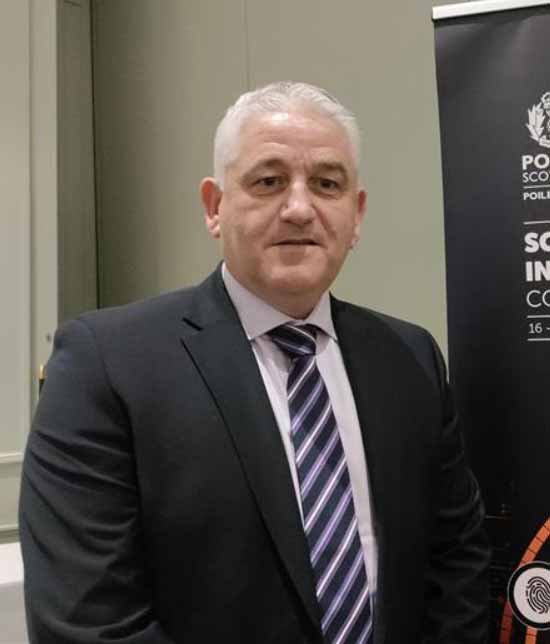
“The hope is it will think like a police officer, an investigator”
Detective Chief Superintendent Paul Livingstone
The year-long pilot project is based on ‘Holmes’, the Home Office Large Major Enquiry System, which was introduced following the Yorkshire Ripper case for dealing with large amounts of data on major investigations.
The pilot started in April, dealing with homicides and rapes investigated by the national task force, as well as rape investigations in the Renfrewshire and Inverclyde division.
A planned extension will cover any type of major incident in the Greater Glasgow, Edinburgh, and Highlands and Islands division, with plans to roll it out to cover all types of serious crime such as organised crime groups, fraud, cyber-crime, high-risk missing people, and fatal crashes.
All UK police forces now have access to the system’s automatic transcription and translation of documents and interviews, and in one case, it was able to process around 5,000 transcripts in only four days.
Livingstone said a secure vault has been created on the system to deal with vast amounts of data, including personal medical information, solving a problem which was costing police forces up to £100,000, and enabling officers to search for relevant information more easily.
“Where before we might have had to put anything from six additional members of staff in to do that work, we don’t need to put any in because the system will do it all for us,” Livingstone said.
“We’ll do it far quicker. In my estimate, if every force in the UK had that problem and had to go and spend £100,000 a year, that’s four and a half million pounds for UK policing that we’ve hopefully avoided [spending].”
He added: “We’re embracing AI being able to come in, which we feel will be really beneficial for unresolved cases – undetected cases from years ago – whereby we’ll be able to run AI over it, and that will be able to read all the documents and come back and give us a report on what’s been done and what’s still to be done.
“We can compare that with other new advances, new investigations, and it will save loads and loads of hours of officers and members of staff poring through old records.
“It will help us with identifying those responsible, and hopefully maybe pointing us in a direction to get that evidence, to hopefully bring them in, arrest them and charge them.
“What we’re actually hoping is that, in the future, once the AI takes in, can that write police reports? Can that write police officer statements?”
He said manual checks would be required, but that this could potentially enable witness or police officer statements to be transferred to the Crown Office and Procurator Fiscal Service at the “click of a button”.
He added: “Ultimately, if the pilot is successful and we can make those enhancements, it will ensure that every investigation that is Holmes-led is fully professional and thorough, and we can then give that reassurance to our communities, to our victims, to survivors that we have conducted a really professional, really thorough investigation, we’ve left no stone unturned, and hopefully give them the answers.”
The two-day SIO conference, titled “Cracking complexity in Serious Crime Investigations”, brought together senior officers from across the UK, as well as representatives from Europol, the Crown Office, the National Crime Agency, and others.
Held for only the second time this year, Police Scotland now plans to make it an annual event.